Abstract
The theory of light transport on Gaussian process implicit surface (GPIS) provides a unified framework for rendering surfaces, participating media, and the intermediate spectrum. However, previous approaches rely on brute-force ray marching for surface intersections, requiring full noise evaluations at each marching point, whether using multivariate Gaussian sampling or sparse convolution noise approximation. This imposes a severe limitation on the rendering efficiency.
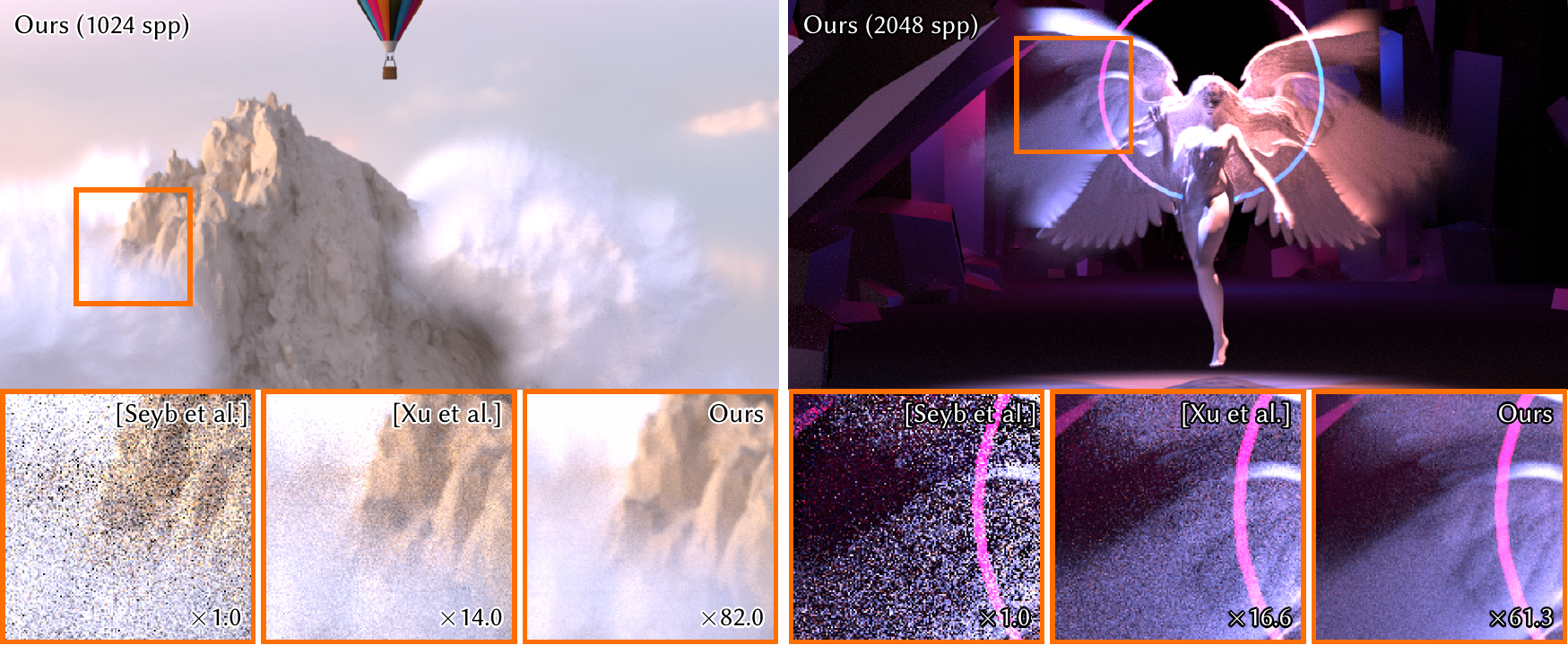
In this paper, we derive bounds to significantly reduce the total number of full noise evaluations, leading to efficient ray marching for ray--surface intersections. We introduce stratified Bernoulli impulses, enabling a fast point-level bound for individual realizations to replace unnecessary full noise evaluations. To further reduce the number of point-level bound evaluations, we propose a region-level bound, leveraging a spatial acceleration structure to prune probabilistically empty regions, thereby avoiding unnecessary marching points in advance. By combining these two bounds, our bounded ray marching accelerates ray--surface intersections in GPIS, and consequently significantly improves overall GPIS rendering efficiency.
BibTeX
@article{chen2026bounding,
  title={Bounding Stratified Bernoulli Impulses for Ray Marching Gaussian Process Implicit Surfaces},
  author={Chen, Junjie and Fan, Zhimin and Yan, Ling-Qi and Zhu, Junqiu and Guo, Yanwen and Zhou, Kun and Guo, Jie},
  journal={ACM Trans. Graph.},
  publisher = {Association for Computing Machinery},
  address = {New York, NY, USA},
  year={2026},
  doi={10.1145/3811311}
  url={https://cchen-77.github.io/projects/bounded-gpis/}
}